
When your heart suddenly pounds, flutters or skips, it is natural to want to make the sensation stop immediately. The safest approach depends on what is causing the palpitation. Simple trigger reduction may help some episodes, while persistent or abnormal rhythms require medical treatment.
Quick Answer
There is no one technique that safely stops every heart palpitation. If the episode is brief and you otherwise feel well, stop what you are doing, sit down, relax, notice whether your pulse feels fast or irregular, and remove an obvious trigger such as excessive caffeine, nicotine, alcohol or exertion. Slow breathing may help when anxiety is contributing. Drink fluids if mild dehydration is likely and you do not have a medical fluid restriction. Do not treat an unknown rhythm with herbs, potassium, magnesium, extra heart medicine or forceful vagal maneuvers. Recurrent, sustained or symptomatic palpitations should be evaluated so the actual rhythm can be identified.
Do Not Try to Stop Emergency Symptoms at Home
Seek urgent or emergency medical care when ongoing palpitations occur with:
- chest pain, pressure or significant tightness;
- severe or sudden shortness of breath;
- fainting or loss of consciousness;
- severe dizziness or near-fainting;
- collapse;
- a sustained very rapid or markedly irregular heartbeat while feeling seriously unwell;
- confusion, severe weakness or signs of shock; or
- rapidly worsening symptoms.
Do not delay emergency assessment while trying breathing exercises, supplements, cold water, herbal remedies or other home treatments.
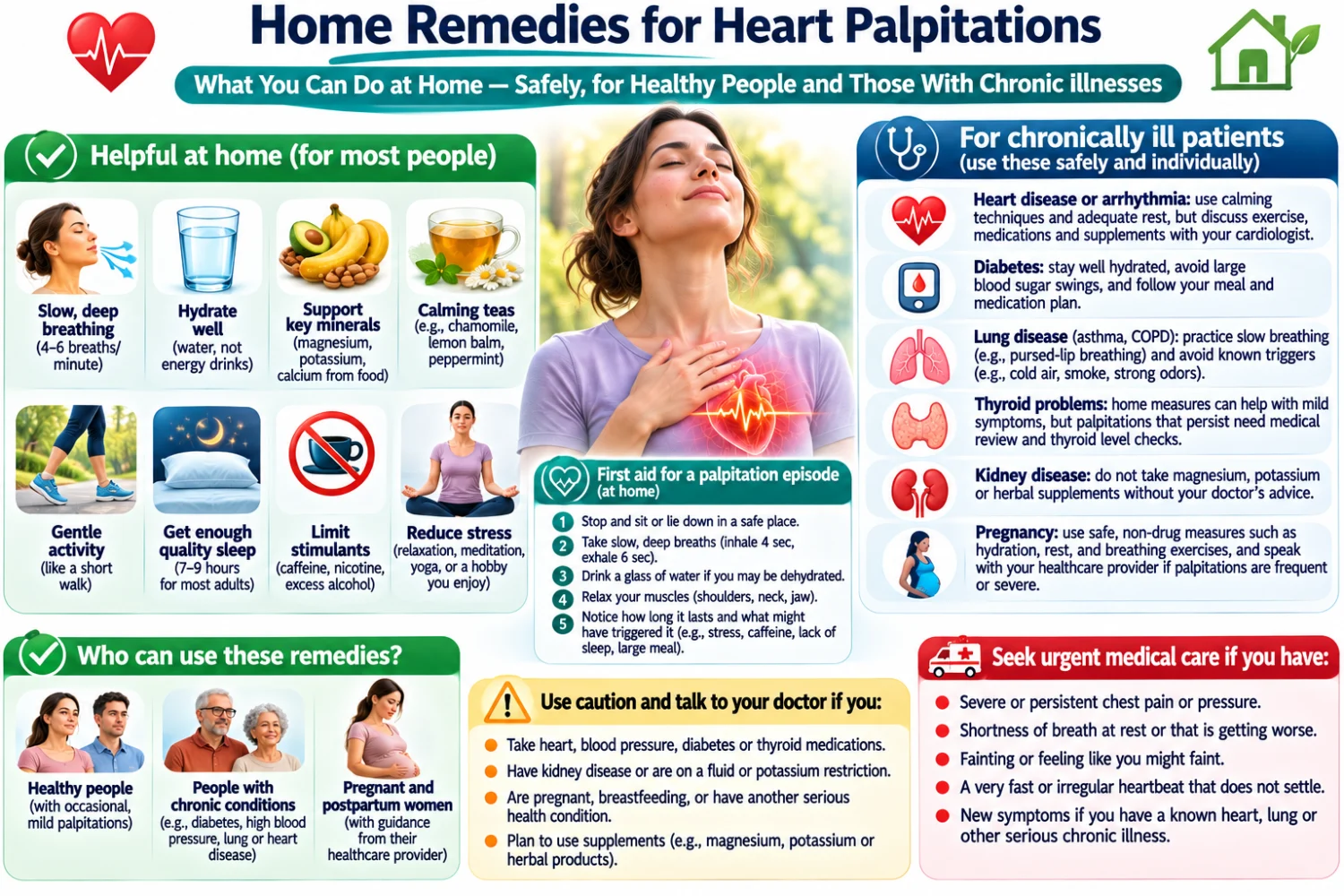
What Should You Do When Heart Palpitations Start?
If you are otherwise stable and do not have emergency warning signs, start by slowing down and observing what is happening.
Stop what you are doing and sit somewhere safe
If the palpitation began during activity, pause and allow your body to settle. Sitting is also safer if you suddenly become lightheaded.
Notice what the heartbeat feels like
Is it racing continuously, irregular, fluttering, pounding or just one isolated skipped beat followed by a thump?
Different rhythms can feel similar, but the description can help your clinician later.
Check your pulse if you can do so comfortably
Notice whether it seems regular or irregular and approximately how fast it is. Do not repeatedly check your pulse if doing so makes anxiety worse.
Note the time
Knowing whether an episode lasts 10 seconds, five minutes or one hour can be more useful than simply remembering that it felt frightening.
Look for an obvious trigger
Think about recent exercise, caffeine, nicotine, alcohol, lack of sleep, emotional stress, fever, dehydration, medicines or supplements.
Watch for additional symptoms
Chest pain, significant breathlessness, fainting, severe dizziness or rapidly worsening symptoms change the situation and may require urgent care.
A skipped sensation may come from a premature contraction, while racing can represent sinus tachycardia, SVT, atrial fibrillation or another rhythm. Some people also feel palpitations while their ECG rhythm is normal. If symptoms recur, recording the rhythm during the episode is more useful than guessing from the sensation.
See our complete guide to heart palpitation symptoms .
Home Care for Otherwise Healthy People With Mild Palpitations
If you are usually healthy, the palpitations are brief and familiar, and there is no chest pain, breathlessness, faintness or other warning sign, simple measures may make you more comfortable. These steps do not prove the rhythm is benign and should not replace evaluation for new, recurring or worsening episodes.
First, stop and sit down
Pause physical activity and sit in a comfortable, safe position. Notice whether you feel an occasional skipped beat, a steady faster pulse or an abrupt sustained racing heartbeat. Check your pulse only if it is easy to do so; repeatedly checking it may increase anxiety and cannot identify the rhythm reliably.
Try relaxed, unforced breathing
Slow and comfortable breathing may reduce distress when anxiety or heightened awareness contributes. Avoid breath-holding, hyperventilation or forceful straining to stop an unknown rhythm. Breathing exercises are for comfort, not a treatment for serious arrhythmias.
Consider fluid loss and obvious triggers
After heat exposure, exercise or mild illness, ordinary hydration may help if you are thirsty and have no fluid restriction. Stop additional caffeine, energy drinks, nicotine and alcohol while symptoms are occurring. Do not take a salt load, electrolyte powder, potassium or magnesium to treat unexplained palpitations.
Rest, regular meals and sleep
Good sleep, balanced meals and moderate activity when you feel well can reduce some triggers over time. Exercise is not an at-home treatment during an active, unexplained racing heartbeat. If episodes start during exercise or you feel faint, stop exercising and obtain medical assessment.
Record the episode
Note its start time, duration, possible triggers, associated symptoms and any heart-rate or rhythm record from a suitable device. An ECG tracing captured during symptoms may help your clinician, although consumer devices can miss arrhythmias.
How Can You Calm Palpitations Caused by Common Triggers?
When palpitations are not caused by structural heart disease or a clinically important arrhythmia, treatment often focuses on reducing triggers.
Reduce excessive caffeine
Caffeine sensitivity varies. Some people can drink coffee without symptoms, while large amounts of coffee, pre-workout products or energy drinks may increase heartbeat awareness or trigger palpitations.
If episodes repeatedly follow caffeine, reducing your intake is reasonable.
Avoid nicotine
Nicotine stimulates the cardiovascular system and can raise heart rate and blood pressure. Cigarettes, vaping and other nicotine products may therefore contribute to palpitations in susceptible people.
Review alcohol intake
Alcohol can trigger palpitations and, particularly with heavier consumption, can precipitate genuine arrhythmias such as atrial fibrillation.
Get enough sleep
Sleep loss can increase autonomic arousal and make the heartbeat feel more noticeable. Improving a disrupted sleep pattern may reduce symptoms when sleep deprivation is a trigger.
Review stimulant medicines
Some decongestants, asthma medicines, ADHD treatments and other stimulants may contribute to palpitations.
Do not stop a prescribed medicine without speaking with the clinician who prescribed it.
Avoid recreational stimulants
Cocaine, methamphetamine and similar drugs can provoke serious tachyarrhythmias and other cardiovascular complications.
Learn more about caffeine and heart palpitations .
Can Slow Breathing Stop Heart Palpitations?
Slow, comfortable breathing may help when stress, anxiety or hyperventilation is contributing to the sensation.
Sit comfortably, relax your shoulders and breathe gently rather than taking repeated forceful breaths.
The aim is to reduce nervous-system arousal, not to force the heart into a different rhythm.
Slow Breathing Is Not a Treatment for Every Arrhythmia
Relaxation may make stress-related pounding or heartbeat awareness less intense.
It does not reliably terminate atrial fibrillation, ventricular tachycardia or another unknown arrhythmia. A persistent rapid or irregular rhythm deserves medical evaluation.
See our detailed guide to anxiety and heart palpitations .
Home Management When You Have a Chronic Illness
Patients with heart disease, diabetes, kidney disease, chronic lung disease or thyroid disorders should use a more individualized approach. Palpitations may reflect an existing rhythm disorder, a medication effect, low blood glucose, dehydration, fluid overload, anemia or another change in health. Do not assume that a remedy safe for a healthy adult is safe for you.
Heart disease, atrial fibrillation and heart failure
Follow the written plan from your cardiologist for previously diagnosed episodes and take medicines only as prescribed. New or worsening palpitations, increasing breathlessness, swelling, chest discomfort or faintness need prompt medical review. People with heart failure may have daily fluid and sodium limits: do not deliberately drink extra water, increase salt or use potassium-containing products unless your treating clinician approves. Do not take additional beta blockers or antiarrhythmics on your own.
High blood pressure and people taking cardiovascular medicines
Measure blood pressure if your clinician has recommended home monitoring, but do not assume a single reading explains palpitations. Diuretics, decongestants and certain other medicines can change pulse, blood pressure or electrolytes. Discuss new symptoms and medicine changes with your clinician rather than stopping, doubling or borrowing medication.
Diabetes and low blood sugar
If you use insulin or medicines that can cause hypoglycemia, check blood glucose when palpitations occur with sweating, shaking, hunger, unusual weakness or confusion. If low, follow your prescribed hypoglycemia action plan; a conscious person able to swallow can generally take rapidly absorbed carbohydrate according to their treatment instructions and recheck glucose. Severe confusion, seizure, unconsciousness or inability to swallow safely is an emergency—never give food or drink by mouth in that situation.
Chronic kidney disease
Potassium and magnesium may accumulate when kidney function is reduced, while potassium levels may also become low due to medicines or other illness. Either abnormality can contribute to heart rhythm problems. Avoid starting mineral supplements, electrolyte beverages, herbal mixtures or extra fluids without medical advice. Arrange assessment for new palpitations, weakness or medicine changes.
Asthma, COPD and other lung disease
Low oxygen levels, respiratory infections and some inhaled bronchodilators can accompany a faster heartbeat. Use your prescribed respiratory action plan and medicines as directed. Do not skip a needed rescue inhaler because of fear of palpitations, but seek medical advice about recurrent symptoms. Severe or worsening breathlessness requires urgent care, not only calming exercises.
Thyroid disorders and anemia
An overactive thyroid or excess thyroid replacement can contribute to tachycardia; anemia may also cause a faster heart rate and fatigue. Home remedies cannot correct these causes. Report recurring palpitations to your doctor for appropriate tests, and do not adjust thyroid medicine or begin iron therapy without appropriate assessment.
Pregnancy, postpartum and older adults
During pregnancy and after delivery, dehydration, anemia and circulatory changes may coexist with potentially serious conditions. Seek urgent care for chest pain, fainting, significant breathlessness or rapid deterioration. Older adults may be taking multiple medicines and have greater risk of falls, orthostatic hypotension or undiagnosed arrhythmias. Review new symptoms promptly rather than relying solely on relaxation methods.
Can Drinking Water Help Heart Palpitations?
It may help when dehydration is contributing to a faster pulse or increased heartbeat awareness.
Dehydration may occur after:
- heavy sweating;
- exercise;
- hot weather;
- fever;
- vomiting;
- diarrhea;
- excessive alcohol intake; or
- poor fluid intake.
If you are mildly dehydrated and have not been told to restrict fluids, drinking water gradually is reasonable.
Water may help when fluid loss is the trigger, but it does not reliably stop SVT, atrial fibrillation or another sustained arrhythmia. People with heart failure, significant kidney disease or prescribed fluid restrictions should follow their clinician’s advice.
What about electrolyte drinks?
Electrolytes such as potassium and magnesium are important for normal cardiac electrical function.
But palpitations do not automatically mean that an electrolyte is low, and electrolyte drinks are not universal palpitation treatments.
Persistent vomiting, diarrhea, heavy sweating, diuretic use or another reason for electrolyte loss may justify blood testing.
Should You Take Magnesium for Heart Palpitations?
Not automatically.
A significant magnesium deficiency can contribute to abnormal cardiac rhythms, and correcting a documented deficiency can be important.
But routine magnesium supplementation has not been proven to stop every PVC, PAC, episode of atrial fibrillation or unexplained palpitation.
Excess magnesium can also become dangerous, particularly in people with impaired kidney function.
Read our detailed article on magnesium and heart palpitations .
Should You Eat Potassium-Rich Foods to Stop Palpitations?
Potassium-rich foods such as vegetables, beans, potatoes and bananas are part of a healthy diet for many people.
However, eating a banana is not a reliable treatment for an unknown palpitation or suspected hypokalemia.
Both low and high potassium can affect the heart’s electrical function. High potassium is particularly dangerous in people with significant kidney disease or certain medications.
Do Not Guess Your Potassium or Magnesium Level
When an electrolyte problem is clinically possible, blood testing and appropriate replacement are safer than treating the sensation of palpitations with mineral supplements on your own.
Can a Vagal Maneuver Stop a Racing Heart?
Sometimes — but only for particular rhythms.
Vagal maneuvers can terminate certain stable, regular supraventricular tachycardias (SVT).
They are not a general treatment for skipped beats, atrial fibrillation or an unidentified irregular heartbeat.
If You Have Previously Diagnosed SVT
If your clinician has documented your SVT and personally taught you which vagal maneuver to use, follow those instructions during an otherwise stable episode.
If the episode is different from usual or accompanied by chest pain, significant breathlessness, fainting, severe dizziness or other signs of instability, seek medical care instead of repeatedly trying maneuvers.
Do Not Experiment With Unknown Rhythms
Do not repeatedly strain, hold your breath forcefully, immerse your face in ice water or try other vagal techniques simply because your heartbeat feels unusual.
Do not perform carotid sinus massage on yourself.
A Practical Five-Step Plan When Palpitations Start at Home
- Check for danger first. Chest pain or pressure, significant breathing difficulty, fainting, collapse, marked confusion or severe dizziness with palpitations requires emergency services. Do not drive yourself.
- Stop and sit or lie safely. Avoid strenuous movement and avoid standing if dizzy.
- Observe without forcing anything. Record the pulse pattern, duration and any other symptoms if you can do so comfortably. Do not perform forceful vagal maneuvers or carotid massage on an undiagnosed rhythm.
- Remove obvious stimulants. Avoid extra caffeine, nicotine and alcohol. Only use hydration appropriate to your existing health conditions and medical restrictions.
- Know when to contact a clinician. New, recurrent, prolonged or worsening symptoms need medical evaluation even if they disappear before an ECG can be performed. If you have a diagnosed arrhythmia, follow your individualized action plan.
Important: A smartwatch pulse reading or an improvement after resting does not rule out a serious arrhythmia. Never treat emergency symptoms with herbal products, supplements, extra prescriptions or breathing techniques alone.
What Should You NOT Do to Stop Heart Palpitations?
Several commonly promoted internet remedies are either unsupported or potentially unsafe when the rhythm has not been diagnosed.
Do not take extra heart medicine
Do not take an extra beta-blocker, calcium-channel blocker or antiarrhythmic dose unless your clinician has specifically given you an individualized plan for that situation.
Do not borrow another person’s medicine
Heart-rhythm drugs can lower blood pressure, slow conduction or worsen certain arrhythmias when used incorrectly.
Do not self-treat with potassium
Potassium replacement should be based on a genuine need. Excess potassium can itself produce dangerous rhythm problems.
Do not take high-dose magnesium automatically
Magnesium helps documented deficiency but is not a universal antiarrhythmic supplement.
Do not rely on herbs
Hawthorn, motherwort, valerian, passionflower, ashwagandha and other herbal preparations are not established treatments for an unidentified cardiac rhythm and may interact with medicines.
Do not assume anxiety
Stress can certainly cause palpitations, but new or changing symptoms should not automatically be attributed to anxiety when other causes remain possible.
Do Natural Remedies Stop Heart Palpitations?
The phrase “natural remedy” covers many very different things.
Healthy lifestyle measures such as adequate sleep, avoiding nicotine, moderating alcohol, reducing an excessive stimulant trigger and maintaining appropriate hydration can be useful.
That is different from claiming that an herb, tea, supplement or food can terminate a cardiac arrhythmia.
Why We No Longer Recommend the Old Herbal Remedies on This Page
The previous version of this article recommended multiple herbal preparations, mineral mixtures and homemade recipes for treating heart palpitations.
Those recommendations have been removed because they cannot safely distinguish a benign heartbeat sensation from a genuine arrhythmia, and several supplements may interact with cardiovascular or other prescription medicines.
What Medical Treatments Can Actually Stop Heart Palpitations?
Medical treatment depends entirely on the cause.
Premature beats
Occasional PACs or PVCs often require no specific treatment. Trigger reduction and reassurance may be enough after appropriate evaluation.
Very frequent or highly symptomatic premature beats may need additional assessment and, in selected cases, medication or ablation.
Supraventricular tachycardia
Depending on the exact rhythm and clinical condition, SVT may be treated with vagal maneuvers, medication, cardioversion or catheter ablation.
Atrial fibrillation
AF management may include rate control, rhythm control, cardioversion, ablation and assessment of stroke risk and anticoagulation.
Bradycardia
Treatment depends on why the heart is slow and whether symptoms correlate with the rhythm. Some people require no treatment, while selected conduction disorders require a pacemaker.
Underlying medical causes
Palpitations caused by anemia, thyroid disease, fever, dehydration, electrolyte abnormalities or medication effects are generally treated by addressing the underlying condition.
Treatment becomes much more precise once an ECG or rhythm monitor shows what the heart was actually doing during the symptom.
How Are Recurrent Palpitations Diagnosed?
If symptoms keep returning, your clinician may use:
- a medical history and physical examination;
- a 12-lead ECG;
- blood tests for anemia, thyroid disease or electrolyte abnormalities when appropriate;
- a Holter monitor for frequent symptoms;
- a patch or event recorder for intermittent episodes;
- echocardiography when structural heart disease is suspected; or
- exercise testing when symptoms consistently occur during exertion.
If the palpitation is not happening during the ECG, the tracing can be normal. A Holter, patch or event monitor can compare the heart rhythm with the exact time you report symptoms.
For frequent symptoms, see constant and frequent heart palpitations .
When Should You See a Doctor?
Arrange medical evaluation when palpitations:
- keep coming back;
- are becoming more frequent;
- last longer than a few minutes repeatedly;
- feel persistently fast or irregular;
- have changed from your usual pattern;
- repeatedly wake you from sleep;
- occur during exercise;
- are associated with dizziness, breathlessness or unusual weakness;
- began after starting or changing a medicine or supplement;
- occur in someone with known heart disease; or
- are interfering with daily life.
For a detailed triage guide, see when to worry about heart palpitations .
Dr. Albana’s Note
When someone asks me, “How do I make these palpitations stop?” my first concern is not finding the fastest trick. I want to understand what the heart is doing. A few forceful beats after too much coffee are very different from a rapid irregular rhythm lasting an hour. If you otherwise feel well, removing a clear trigger, resting, correcting mild dehydration and calming anxiety may help. But if the episodes keep returning, the most useful next step is often to capture the rhythm with an ECG or monitor. Once we know the rhythm, treatment becomes much safer and more specific.
When to Seek Emergency Care
Seek urgent or emergency medical care if ongoing palpitations occur with:
- chest pain, pressure, squeezing or significant tightness;
- severe shortness of breath;
- fainting or loss of consciousness;
- collapse;
- severe dizziness or near-fainting;
- a sustained very rapid or markedly irregular heartbeat while feeling seriously unwell;
- confusion, severe weakness or signs of shock; or
- rapidly worsening symptoms.
If chest symptoms occur, see our chest pain and heart palpitations article for additional education.
If difficulty breathing accompanies the episode, see heart palpitations and shortness of breath , but seek urgent care first when emergency warning signs are present.
Most Asked Questions
How can I stop heart palpitations immediately?
There is no single safe method that immediately stops every palpitation. If you otherwise feel well, sit down, rest, remove an obvious stimulant trigger and use slow breathing if anxiety is contributing. A sustained fast or irregular rhythm needs medical evaluation rather than repeated home remedies.
How can I calm heart palpitations at home?
For mild symptoms without warning signs, reducing stress, resting, avoiding excessive caffeine or nicotine, limiting alcohol, getting adequate sleep and correcting mild dehydration may help when those factors are contributing.
Does drinking water stop heart palpitations?
It may help if dehydration is contributing to a faster pulse. Water does not reliably terminate an arrhythmia such as atrial fibrillation or SVT.
Can deep breathing stop heart palpitations?
Slow comfortable breathing may reduce stress-related heartbeat awareness. It is not a reliable treatment for an unknown cardiac arrhythmia.
What is the best natural remedy for heart palpitations?
There is no proven natural product that treats all palpitations. Healthy measures such as adequate sleep, appropriate hydration and reducing a personal stimulant trigger are safer than treating an unidentified rhythm with herbs or supplements.
Does magnesium stop palpitations?
Magnesium replacement can help when magnesium deficiency contributes to an abnormal rhythm. Routine magnesium supplementation has not been proven to stop every PVC, PAC or unexplained palpitation.
Will eating a banana stop heart palpitations?
No. Bananas are nutritious potassium-containing foods, but they are not an immediate treatment for an unknown rhythm. Significant potassium abnormalities should be measured and treated appropriately.
Can I use the Valsalva maneuver to stop palpitations?
Vagal maneuvers can help certain stable, regular SVTs. They are not appropriate for every palpitation. If you have diagnosed SVT, your clinician can teach you when and how to use an appropriate maneuver.
What medicine stops heart palpitations?
There is no single palpitation medicine. Beta-blockers, calcium-channel blockers, antiarrhythmics, cardioversion and ablation are used for specific diagnoses. Treatment should follow the actual rhythm rather than the symptom alone.
How long should I wait for heart palpitations to stop?
There is no universal safe waiting period. A brief isolated skipped beat is very different from a rapid rhythm lasting minutes or hours. Recurrent episodes lasting longer than a few minutes deserve medical assessment, particularly if they are new or changing.
Can anxiety cause palpitations that keep coming back?
Yes. Anxiety can increase heart rate and heartbeat awareness. However, recurrent palpitations should not automatically be attributed to anxiety before other relevant causes have been considered.
When should I go to the hospital for palpitations?
Seek emergency medical care when ongoing palpitations occur with significant chest pain or pressure, severe shortness of breath, fainting, near-fainting, severe dizziness, collapse or rapidly worsening symptoms.
Related Heart Palpitation Guides
Medical References
- American Heart Association. How Serious Are Heart Palpitations? Causes, Symptoms and When to Worry. Published February 9, 2026. American Heart Association .
- American Heart Association. Symptoms, Diagnosis and Monitoring of Arrhythmia. Last reviewed October 10, 2024. American Heart Association .
- American Heart Association. Common Tests for Arrhythmia. American Heart Association .
- American Heart Association. Adult Tachyarrhythmia With a Pulse Algorithm. 2025 CPR & ECC Guidelines. American Heart Association .
- American Heart Association. Tachycardia: Fast Heart Rate. American Heart Association .
- NHS. Heart Palpitations. Last reviewed March 17, 2026. NHS .
- Mayo Clinic. Heart Palpitations: Symptoms and Causes. Mayo Clinic .
- Mayo Clinic. Heart Palpitations: Diagnosis and Treatment. Mayo Clinic .