
ANXIETY & STRESS
Anxiety Palpitations vs Arrhythmia: Differences and Warning Signs
Anxiety can cause a racing or pounding heart, but symptom patterns alone cannot reliably distinguish anxiety from an arrhythmia.
Updated: November 9, 2026
Written by: Dr. Albana Greca, MD, MMedSc, Family Physician, IDF Fellow
Medically reviewed by: Dr. Benard Shehu, Cardiologist
Quick Answer
Anxiety usually increases the rate of a normal sinus rhythm through adrenaline and the fight-or-flight response. Arrhythmias involve an abnormal heart rhythm, such as extra beats, supraventricular tachycardia (SVT), or atrial fibrillation. Panic often accompanies a gradual heart-rate increase, while some SVT attacks start and stop abruptly; however, these patterns overlap. No symptom pattern or home pulse check can reliably rule out an arrhythmia. A clinician may need an ECG recorded during symptoms or longer rhythm monitoring.
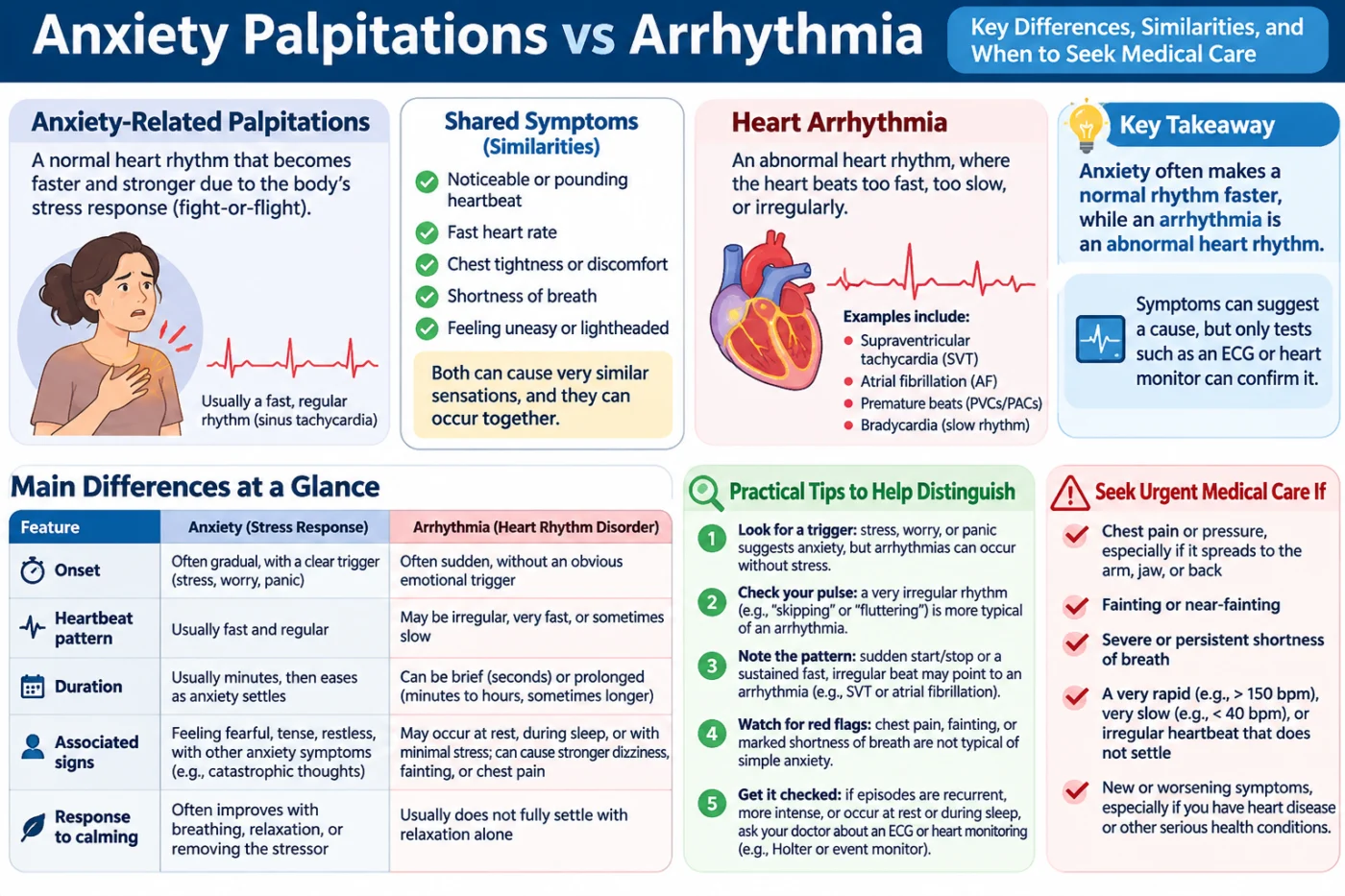
Key Medical Takeaways
- Anxiety-related symptoms and arrhythmias can overlap.
- An ECG captured during symptoms can clarify the rhythm.
- Recurrent or unexplained episodes should not automatically be labeled anxiety.
- Chest pain, fainting, collapse or severe breathlessness require emergency care.
How Are Anxiety Palpitations and Arrhythmias Similar?
Both anxiety and arrhythmias can cause a racing, pounding, fluttering or skipping sensation in the chest or neck. Sweating, shaking, dizziness, breathlessness and chest discomfort may occur with either. A person with a true rhythm disturbance may feel frightened because of the unexpected heartbeat; someone with panic may feel their normally conducted heartbeat much more intensely.
What happens during anxiety? The sympathetic nervous system releases adrenaline, increasing heart rate and the strength of contractions. Breathing faster or deeper than necessary can lower carbon dioxide and contribute to tingling, dizziness and a sensation of not getting enough air. Fear of these sensations may intensify the stress response.
What happens during arrhythmia? The heart’s electrical rhythm becomes abnormal. Premature beats can feel like a skipped beat followed by a thump. SVT may produce a sudden, rapid, often regular heartbeat. Atrial fibrillation may produce an irregular heartbeat, sometimes accompanied by fatigue or exercise intolerance. Some arrhythmias are relatively benign, while others need treatment.
They can coexist. Someone with anxiety can also have atrial fibrillation or SVT. Equally, an arrhythmia can provoke panic. Feeling anxious during an episode must never be treated as proof that it is harmless.
Anxiety vs Arrhythmia: Key Differences and Practical Clues
Gradual heart-rate increases during fear may reflect a stress response, while a racing heartbeat that begins or ends suddenly, as though a switch was flipped, can suggest SVT. Nevertheless, panic attacks can start abruptly, and arrhythmias may occur during stressful situations. Recording the rhythm during symptoms is more reliable than deciding on the basis of sensations alone.
| What you notice | Common with anxiety | May suggest arrhythmia |
|---|---|---|
| Beginning | Often builds with fear or stress | Some tachycardias start very suddenly |
| Heartbeat pattern | Usually fast but regular sinus rhythm | Very rapid regular rhythm, irregularity or extra beats |
| Trigger | Fear, poor sleep or stress | May begin during rest or exertion without obvious fear |
| Ending | May ease as distress resolves | Some episodes stop abruptly or persist |
| Confirmation | Assessment and rhythm documented during symptoms | ECG or ambulatory rhythm recording |
Important: These are clues, not diagnostic rules. A regular pulse does not exclude SVT, and an irregular sensation does not necessarily indicate a dangerous condition.
Five details worth noting
1. Which came first? Did fear build before the pounding, or did your heart suddenly race while you were calm? Tell your clinician the sequence.
2. How did it start and stop? Note whether onset and offset were abrupt or gradual. Do not assume that sudden symptoms automatically mean a dangerous rhythm.
3. Was the heartbeat steady or uneven? If safe to observe, mention regularly spaced beats, isolated thumps, or persistent irregularity. Do not repeatedly check your pulse if doing so worsens anxiety.
4. What were you doing? Palpitations during exercise or with near-fainting deserve particular attention. Record medicines, caffeine, stimulants and recent illness.
5. Was the rhythm captured? A wearable ECG may provide useful information if available, but smartwatches can miss rhythms or generate false alerts. Never delay urgent medical help to obtain a recording.
When Is It Unsafe to Assume Anxiety?
Emergency symptoms: Ongoing palpitations that will not settle, especially with chest pain or pressure, significant breathlessness, fainting, collapse or feeling about to faint, require emergency assessment. Call your local emergency number; do not drive yourself. If these warning symptoms have stopped, arrange urgent assessment.
Other higher-risk scenarios: Episodes that begin during exercise, new palpitations with known heart disease, a strong family history of sudden unexplained death or inherited rhythm disorders, and attacks becoming more frequent, prolonged or different from usual need medical review. A previous diagnosis of panic disorder does not exclude a new cardiac problem.
How the situation may differ by age or health history
Teenagers and young adults: Stress and energy drinks can cause palpitations, but SVT and inherited rhythm conditions can also present at younger ages. Fainting with exercise or a concerning family history should not be attributed to school stress alone.
Women: Hormonal changes, pregnancy or menopause may affect heartbeat awareness, but anemia, thyroid disease and arrhythmias remain possibilities. Do not automatically label unexplained racing episodes as hormonal or emotional.
Older adults: Atrial fibrillation becomes a more important consideration with age. New irregular palpitations, unusual fatigue, dizziness or reduced exercise tolerance should be assessed even without severe chest pain.
People with chronic illness: Coronary disease, heart failure, valve disease, thyroid disorders and medications can change the risk profile. Bring a complete medicine and supplement list to your visit.
How Can a Doctor Confirm Anxiety or an Arrhythmia?
The starting point is a detailed symptom history, examination and a 12-lead ECG. Your clinician will ask about the timing, duration, exercise, associated dizziness or chest discomfort, medications, family history and existing cardiac conditions. An ECG can detect an arrhythmia when it is happening and may reveal other clinically important findings even between attacks.
If the ECG is normal but symptoms are intermittent, a Holter monitor, longer patch monitor or event recorder may be recommended. Matching your symptoms to the electrical rhythm is often the most useful distinction. A normal brief ECG does not prove that previous palpitations were anxiety.
Blood tests for anemia, thyroid disorders or electrolyte disturbances may be appropriate. Echocardiography or exercise testing may be used for selected patients. Assessment and treatment of anxiety, including cognitive behavioral therapy when indicated, can proceed alongside cardiac evaluation rather than replacing it.
What can you do safely during an episode?
First assess for the emergency warning signs above. If none are present and this is a familiar episode previously assessed by your clinician, sit safely, breathe gently without forcing deep breaths and use grounding techniques. Avoid paper-bag breathing and do not try unprescribed medications or forceful maneuvers to stop a racing heart.
After the episode, note how it started, how long it lasted, the sensations and any heart-rate or ECG recording. If episodes recur or change, arrange clinical review. See first aid for palpitations during a panic attack and what a normal ECG does and does not mean.
Emergency Warning Signs
Call your local emergency number now for ongoing palpitations that will not settle or for palpitations accompanied by chest pain or pressure, significant shortness of breath, fainting, collapse or feeling close to fainting. Do not drive yourself. If these warning symptoms have stopped, seek urgent medical evaluation.
Frequently Asked Questions
Can anxiety and a heart rhythm problem happen together?
Yes. Having anxiety does not exclude an arrhythmia, and symptoms should be assessed according to risk.
Can an ECG be normal between episodes?
Yes. A resting ECG may miss an intermittent arrhythmia. A clinician may recommend longer rhythm monitoring if the history suggests it.
Can SVT be mistaken for a panic attack?
Yes. SVT can cause sudden rapid heartbeat, dizziness and anxiety. A rhythm tracing during symptoms helps distinguish it from sinus tachycardia.
Does a regular, fast heartbeat mean anxiety?
No. Both sinus tachycardia and some arrhythmias, including SVT, can feel regular. The heartbeat pattern alone is not a diagnosis.
Can anxiety and atrial fibrillation happen together?
Yes. Anxiety does not prevent atrial fibrillation, which may need treatment and assessment of stroke risk.
Related Reading
References
- NHS Heart Palpitations
- NICE CG113 Generalised anxiety disorder and panic disorder in adults
- NICE NG196 Atrial fibrillation diagnosis and management
- American Family Physician: Palpitations evaluation and monitoring (2024)
- American Family Physician: Supraventricular tachycardia (2023)
- NHS: Heart rhythm problems
This page is educational and does not substitute for individual medical assessment.
Further Clinical Guidance
Why onset and duration are useful but insufficient
Some supraventricular tachycardias start and stop abruptly; a stress-related increase in sinus heart rate often rises and falls more gradually. There is overlap, and no symptom description reliably substitutes for an ECG recorded during an event.
What a clinician asks about
History should include triggers, exercise, duration, whether the pulse feels regular, associated faintness or chest pain, family history of sudden cardiac death, medication exposure and any prior cardiac condition.
A practical route to diagnosis
Start with assessment and a resting ECG. If episodic symptoms are not captured, a Holter or longer monitor may help. An anxiety assessment can proceed in parallel rather than replacing a cardiac evaluation when indicated.
For further evaluation, see our guide to ECG, Holter monitoring and normal results.
Related guide: Anxiety, Stress & Heart Palpitations — Complete Guide.