
Tests and Normal Results · Wearable Heart Monitoring
Can a Smartwatch Detect Heart Palpitations? ECG, Alerts and Limits
A smartwatch can sometimes record useful heart rhythm information during palpitations. But pulse alerts, single-lead ECGs and medical-grade heart monitors are not interchangeable.
Medically reviewed by: Dr. Benard Shehu, Cardiologist
Quick Answer
Yes, some smartwatches can help detect and document heart palpitations. A compatible ECG watch may record a brief rhythm tracing during symptoms, and optical sensors may identify an irregular pulse or unusually high heart rate. However, watches can miss short episodes, premature beats, SVT and other arrhythmias. A smartwatch alert does not establish a diagnosis, and a normal result does not exclude a heart rhythm disorder.
Key Medical Takeaways
- Optical pulse sensing and smartwatch ECG are different technologies.
- Some watches help flag possible atrial fibrillation, but algorithms cannot identify every rhythm.
- Wearable ECG captured during symptoms can be helpful for clinical interpretation.
- Continuous medical-grade monitors remain important when episodes are brief or clinically concerning.
- Never delay emergency care because of a reassuring smartwatch display.
How smartwatches detect heart activity
A smartwatch may measure your pulse using an optical sensor (photoplethysmography, or PPG). Some models also offer a user-initiated single-lead electrocardiogram (ECG). These are different technologies: a pulse sensor measures changes in blood volume, whereas an ECG records electrical signals from the heart.
A racing-heart notification or irregular pulse alert is not the same as a confirmed arrhythmia diagnosis. The exact features vary by model, region, software version and eligibility.
Palpitations describe what you feel, not something a watch can directly sense. A watch records selected pulse or electrical information that may help explain that feeling. I want you to use those records as part of a conversation with your clinician, rather than expecting the device to provide a complete answer.
What can a smartwatch ECG show during palpitations?
On compatible devices, an ECG recording started while you are feeling palpitations may help a clinician see whether the rhythm is regular or irregular at that moment. Some algorithms can flag a tracing compatible with atrial fibrillation (AF), while others may report sinus rhythm, high or low heart rate, or an inconclusive result.
Most consumer smartwatch ECGs are single-lead recordings, not equivalent to a medical 12-lead ECG. They cannot reliably classify every tachycardia, determine every cause of skipped beats, or exclude structural heart disease or heart attacks. Professional review of a recording may be needed.
An automatic label and the actual tracing are different pieces of information. Even an “inconclusive” ECG may contain information a clinician can review, while a “sinus rhythm” label is not a comprehensive heart-health assessment. Save the original tracing when possible, with its time and your symptoms.
What do irregular rhythm and heart-rate alerts mean?
Optical irregular-rhythm notifications typically sample your pulse intermittently and use algorithms designed mainly to identify possible AF. No alert does not mean no arrhythmia, and an alert does not prove AF. A high heart-rate alert may reflect exertion, anxiety, illness, dehydration, medication effects or an arrhythmia.
Movement, loose fit, skin contact, sensor characteristics and rhythm type can all affect readings. If an alert is repeated or accompanies symptoms, discuss it with a clinician.
Do not assume that an alert refers to the present moment. Depending on the feature, analysis may happen later after syncing. For example, Google/Fitbit irregular-rhythm notifications are not analyzed in real time. Check the date and time of the underlying readings and tell your clinician whether you felt symptoms then.
Can a smartwatch miss palpitations or SVT?
Yes. Brief episodes can end before you open the ECG app, and many watches do not record a continuous ECG. Regular fast rhythms such as some forms of supraventricular tachycardia (SVT) are not necessarily identified accurately by AF-focused algorithms. Isolated premature atrial (PAC) or ventricular (PVC) beats may cause a noticeable thump but not generate any smartwatch notification.
If episodes last only seconds, a continuous medical-grade Holter, ECG patch or event recorder may be more informative. Read how a normal ECG can miss an intermittent arrhythmia.
Detection also depends on whether the watch was actually collecting usable data. Charging, a flat battery, loose contact, movement, disabled settings or a feature not available for your device can all leave gaps. Even with ideal wear, no alert should be interpreted as proof that an episode did not happen.
How accurate are smartwatch readings and alerts?
There is no single accuracy percentage that applies to every watch, feature, rhythm and person. Measuring pulse rate, identifying possible AF and interpreting a single-lead ECG are different tasks. A study of readable recordings in selected adults does not show how often the device will capture your brief episodes during everyday life.
A false alert suggests a problem that clinical review does not confirm; a missed alert occurs when a problem is present but the watch does not flag it. Movement and poor contact can affect signals, while intermittent sampling and AF-focused algorithms can miss other rhythms. An accurate pulse number is not the same as an accurate rhythm diagnosis.
Ask what the manufacturer’s performance claim actually measured, who was studied and whether inconclusive recordings were excluded. The likelihood that an alert represents disease also depends on the clinical setting, so findings in high-risk older adults should not be applied uncritically to healthy teenagers. Symptoms and professional interpretation remain central.
Watch placement, strap fit and skin contact
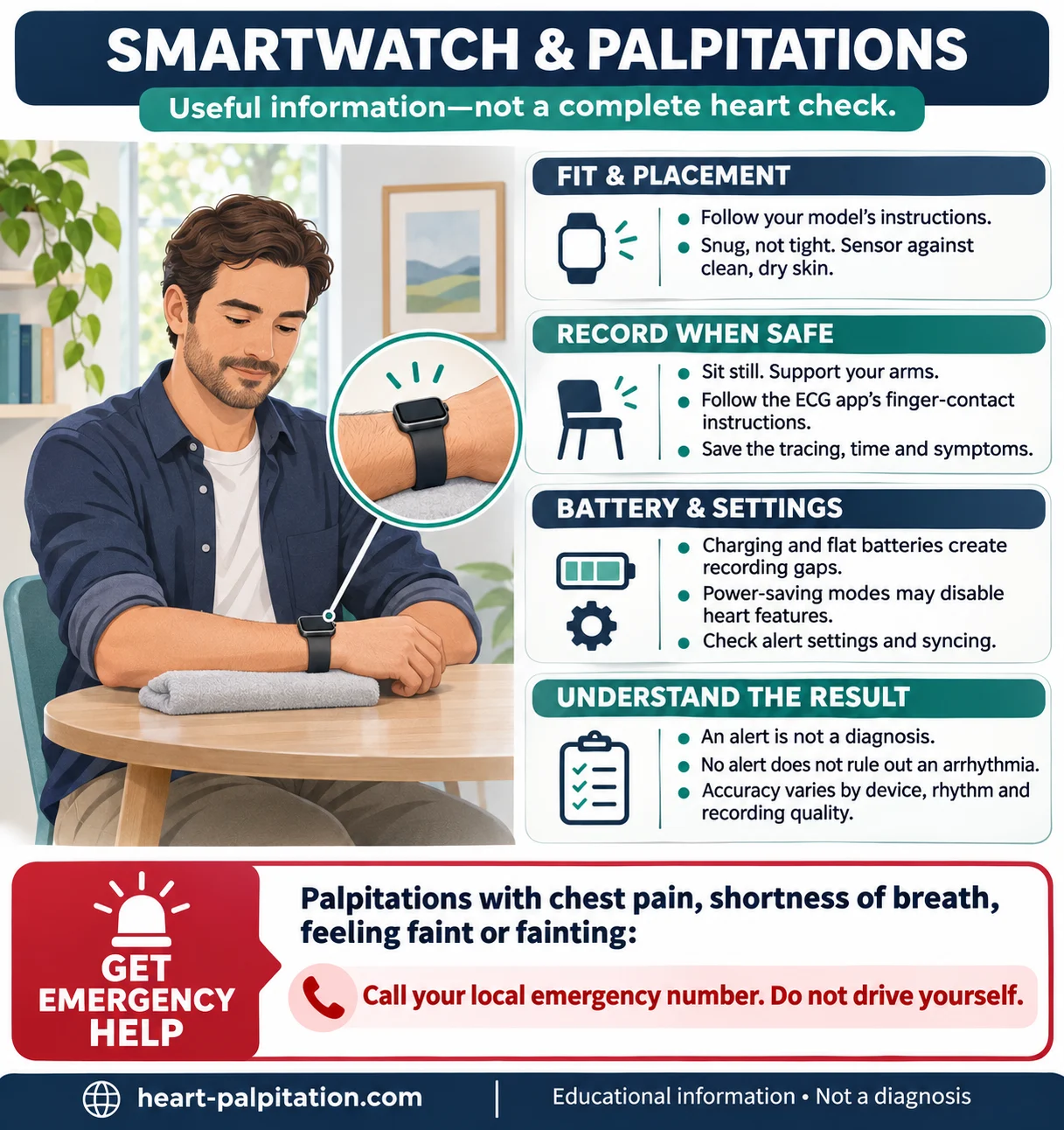
Use the position recommended for your model, usually on the top of the wrist with the back sensor against bare skin. Apple advises wearing its watch above the wrist bone toward the elbow, rather than resting on the bony prominence near the hand. Make sure any wrist-orientation setting matches the wrist you are using.
The strap should keep the sensor stable without pain, numbness, swelling or deep marks. A loose watch can lift away from the skin; an excessively tight one is not a solution. Clean and dry the watch and skin according to the instructions, and adjust the fit if sweat or movement makes it slip.
Cold skin, reduced circulation, tattoos or scars can affect some optical readings. Follow troubleshooting guidance and, where appropriate, try the other wrist and update orientation settings. Do not use adhesives or cover sensors to force a reading. Persistent skin irritation needs a break from wear and advice if it does not settle.
Battery life, charging gaps and power-saving modes
A watch cannot record while switched off, out of charge or removed for charging. Plan charging around your routine if you want to capture a particular time of day, and note gaps when sharing records. Battery life varies with model, battery condition, settings and use, so a general advertised figure cannot guarantee monitoring coverage.
Power-saving settings may change heart monitoring before the battery is empty. As a specific example, Apple’s Low Power Mode disables background heart-rate measurements and high, low and irregular-rhythm notifications. Other brands and modes differ; check the current instructions rather than assuming battery-saving features preserve every health function.
A low battery percentage should not be treated as a medical explanation for an abnormal pulse. It may reduce available monitoring, but you cannot decide that an alert is false—or a symptom harmless—because the watch needs charging. Do not delay care while looking for a charger or trying to reconnect the device.
Setup, notifications, syncing and everyday use
Check that the exact watch supports the feature, that it is available in your country, and that the companion app and watch software are compatible and up to date. Heart-rate alerts, irregular-rhythm notifications and on-demand ECG may need separate setup. A basic pulse display does not mean all three are active.
Review relevant permissions, alert settings, wrist detection and syncing instructions. Phone notification settings can affect whether you see an alert, while some features analyze data only after transfer. If a setting changes or you move to another watch, verify the health features rather than assuming the previous setup carried over.
Agree with your clinician what to save and when to make contact. Keep a small number of useful tracings with symptoms and time, and use secure sharing where possible. Repeatedly checking every fluctuation can increase worry; a planned recording and follow-up approach is often more useful than watching the display continuously.
Smartwatch versus medical monitoring
| Device | Useful for | Key limitation |
|---|---|---|
| Smartwatch optical sensor | Heart-rate trends and possible irregular-pulse alerts | Does not continuously record ECG or reliably identify every arrhythmia |
| Smartwatch ECG | Brief tracing captured while symptomatic | Usually on-demand single-lead recording; may miss brief episodes |
| 24–48-hour Holter | Continuous ECG and frequent or daily symptoms | May miss events on other days |
| Multi-day ECG patch / event monitor | Less frequent intermittent episodes | Requires selection based on symptom frequency and clinical assessment |
A smartwatch may help document an episode between appointments, but it should not replace a monitor prescribed for a particular diagnostic question. Ask what information the clinician needs: a readable ECG during symptoms is more informative than a screenshot showing only a pulse number.
Choose monitoring according to symptoms, frequency and clinical risk rather than the number of health features advertised. You do not need to buy a watch to have palpitations investigated, and owning one does not remove the need for a clinical examination.
How to record an episode usefully
- When safe, stop moving and sit down, then follow the device’s instructions for an ECG recording if your watch offers that feature.
- Record the time, symptom onset, duration, activity and how you felt (fluttering, skipped beats or racing).
- Save the ECG tracing or export the original PDF if supported; keep the date and time visible.
- Share recordings with your clinician rather than relying only on the app’s automatic label.
- If symptoms recur and no useful tracing is captured, ask whether medical-grade monitoring would be more appropriate.
Do not keep trying to obtain a smartwatch recording instead of seeking urgent medical care when warning signs are present.
If you are otherwise well enough to record, sit still with your forearms supported and follow the manufacturer’s contact instructions. For an Apple Watch ECG, for example, the opposite hand’s finger touches the Digital Crown without pressing it. Other models use different contacts; do not assume one brand’s method applies to yours.
If a recording is poor, correct fit or movement and try again once you are comfortable. Repeated failed recordings are a reason to discuss another way to capture symptoms, not to tighten the strap painfully or keep testing while unwell. Do not change medicines or provoke an episode to obtain a tracing.
Age, life stage and chronic illness: using the watch in context
Children, teenagers and younger adults
Do not assume adult AF features are suitable for a child. Some features have minimum-age restrictions; Apple’s irregular-rhythm notification and ECG features, for example, are not intended for people under 22. This is a feature restriction, not evidence that younger people cannot have a rhythm problem. Do not enter a false age to enable it.
A young person with recurrent sudden racing, exercise symptoms, fainting or an important family history needs assessment even without alerts. A pediatric clinician should interpret pulse rates and decide how to record episodes. A sports watch can provide context, but an adult algorithm should not determine whether a child needs care.
Otherwise healthy men and women
A fit or healthy adult may see a transient high pulse with exercise, illness, stress or stimulants, or an isolated unusual reading caused by poor signal. If you feel well, review the circumstances and recording technique rather than repeatedly reacting to a single number. Persistent or recurring abnormalities deserve medical review.
Neither male nor female sex guarantees accuracy or identifies the cause of palpitations. Age, symptoms, skin contact, activity and the device’s intended use all matter. A normal display should not override new chest pain, breathlessness or faintness.
Pregnancy, postpartum and menopause
Palpitations can become more noticeable during pregnancy or around menopause, but an app cannot tell whether hormones, anemia, thyroid disease or an arrhythmia explains them. Device evidence and eligibility may not cover every life stage. Bring relevant records to your maternity team or clinician without treating a normal label as pregnancy-specific reassurance.
During pregnancy or after a recent birth, new fast or pounding heartbeat warrants prompt advice; chest pain, breathlessness or faintness needs emergency assessment. In menopause, discuss troublesome symptoms and changes in pattern rather than automatically blaming hormones. Treatment decisions should not be based on watch labels alone.
Older adults and patients with known AF or heart disease
A watch may provide useful extra information, but some screening features are not intended for people already diagnosed with AF. Apple’s irregular-rhythm notifications and AFib History, for example, have different intended uses and eligibility. Ask which feature, if any, fits your care plan.
Pacemakers, implanted defibrillators and rhythms outside an app’s classification range may lead to inconclusive results or fall outside intended use. Follow your specialist’s monitoring advice. Do not stop anticoagulants, add heart medication or decide that AF has resolved because a watch shows sinus rhythm.
Diabetes, kidney disease, thyroid or lung conditions
Palpitations may accompany low glucose, anemia, thyroid dysfunction, an electrolyte disturbance or medicine effects. A watch cannot measure those causes through its pulse sensor. Follow an established diabetes hypo plan when relevant, and discuss recurrent symptoms and medication timing with your clinical team.
In kidney disease or heart failure, do not respond to an alert by increasing fluids or taking potassium or magnesium without advice. With asthma or COPD, do not stop prescribed inhalers yourself. A readable ECG can be helpful, but blood tests, clinical examination or prescribed monitoring may answer questions the watch cannot.
What to do with an abnormal or normal reading
An abnormal reading should be assessed alongside symptoms, medical history and, if indicated, a clinical ECG. An alert alone should not lead you to start blood thinners, antiarrhythmic drugs or supplements.
A normal watch reading can be reassuring for that measurement, but does not rule out intermittent arrhythmia. If palpitations continue, see daily palpitations despite normal tests or discuss a suitable heart monitor with your clinician.
If you feel well after a new or repeated irregular-rhythm notification, arrange medical review and bring the underlying record. An unreadable or inconclusive result is not a diagnosis either. If symptoms are concerning, seek help based on how you feel rather than waiting for the device to classify them.
When to seek urgent medical help
Call your local emergency number for current palpitations with chest pain, shortness of breath, feeling faint, fainting or collapse. Do not drive yourself. A normal watch reading, no alert or a flat battery must not delay care. If these warning symptoms have stopped, arrange an urgent medical assessment.
Seek timely assessment for new or worsening episodes, exercise-related symptoms, known heart disease or a family history of sudden cardiac death.
Most Asked Questions
Can an Apple Watch or another smartwatch detect atrial fibrillation?
Some compatible devices can flag possible AF through irregular-pulse notifications or an ECG algorithm. A clinician may need to confirm the rhythm from a readable ECG tracing.
Availability and eligibility depend on model, country and software. Save the underlying ECG or alert details; a marketing claim or automatic label is not a substitute for reviewing the actual record.
Can a smartwatch diagnose SVT?
Not reliably. A recorded single-lead ECG might help a clinician interpret the episode, but AF-focused algorithms do not reliably classify all regular fast rhythms.
If episodes are too brief to record or the app cannot classify them, discuss a prescribed monitor rather than repeatedly trying to trigger a watch alert.
Why does my watch say sinus rhythm when I feel palpitations?
Your rhythm may genuinely be sinus rhythm, you may be feeling occasional premature beats, or the episode may have ended before the recording. A clinician can review the tracing.
Save the tracing with the symptom time and ask your clinician whether it captured the usual episode. A label generated after symptoms stop may not explain what happened earlier.
Does no irregular rhythm alert mean my heart is normal?
No. Optical monitoring may be intermittent and can miss short or regular arrhythmias. It does not assess every aspect of cardiac health.
Check fit, battery, setup and syncing, but remember that correctly functioning features still do not detect every episode or every condition.
Should I use a smartwatch instead of a Holter monitor?
Not when prescribed monitoring is clinically indicated. A Holter or ECG patch records rhythm over a defined period and may capture episodes a watch cannot.
Charging gaps, intermittent sampling and user-initiated ECGs can leave important episodes unrecorded. Follow the prescribed monitoring plan even if you also wear a watch.
Can a smartwatch detect a heart attack?
No. Consumer smartwatch ECG and pulse alerts cannot rule out a heart attack. Chest pain or other severe symptoms require urgent medical assessment.
Do not keep repeating ECGs to obtain reassurance while having warning symptoms. Emergency assessment relies on symptoms, examination and appropriate medical tests, not the watch display.
Related Guides
Medical References
- American College of Cardiology. Smartwatches and Atrial Fibrillation: What Works and What Needs Improvement? 2024. Read article.
- JACC Scientific Statement. Promises and Perils of Consumer Mobile Technologies in Cardiovascular Care. Read statement.
- Japanese Heart Rhythm Society / Japanese Circulation Society. 2025 Consensus Statement on the Appropriate Use of Ambulatory and Wearable Electrocardiographs. Read consensus.
- American College of Cardiology. Guidance on Apple Watch for Heart Health Monitoring. 2025. Read guidance.
- Apple: Heart health notifications.
- Apple: Take an ECG with the ECG app.
- Apple: Wearing your Apple Watch.
- Apple: Battery life and Low Power Mode.
- Google Health: Irregular Rhythm Notifications.
- Google Health: ECG app.
- NHS: Heart palpitations.
- CDC: Urgent Maternal Warning Signs.
Explore this topic: Heart Palpitation Tests & Normal Results — complete diagnostic guide.