
Tests & Normal Results · Heart Rhythm Diagnosis
Heart Palpitations Every Day but Tests Are Normal: What Next?
If you are still having heart palpitations after normal heart tests, it does not mean your symptoms are imaginary. Understanding what was tested and whether symptoms occurred during testing helps determine the next step.
Medically reviewed by: Dr. Benard Shehu, Cardiologist
Updated: November 6, 2026
Quick Answer
Daily palpitations can continue despite a normal ECG, echocardiogram or blood tests. Reasons include premature beats, increased awareness of a normal heartbeat, stimulants, medical conditions and intermittent arrhythmias. A Holter monitor is often helpful for daily symptoms, especially when it captures the rhythm during the usual sensation. Normal tests are reassuring, but their meaning depends on which tests were performed and whether concerning symptoms are present.
Key Medical Takeaways
- Daily symptoms do not necessarily mean a dangerous heart condition.
- A normal ECG between episodes may miss intermittent arrhythmias.
- A symptom-rhythm correlation is usually more useful than repeating a short ECG.
- Chest pain, fainting or severe breathlessness need emergency assessment, even after normal tests.
Why daily palpitations can occur with normal tests
Feeling your heartbeat every day can be distracting or frightening, especially when your ECG, echocardiogram or blood tests have been described as normal. The important distinction is between a symptom that is real and an arrhythmia that has actually been documented. Some people perceive normal beats intensely; others experience occasional premature atrial or ventricular contractions (PACs or PVCs), or short rhythm episodes not present during an office test.
A normal test cannot answer every question. A resting ECG describes the rhythm during its brief recording, an echocardiogram evaluates heart structure and function, and blood tests look for selected medical contributors. They examine different aspects of health.
When you tell me, “I feel this every day, so how can the tests be normal?”, I want to take both the symptoms and the results seriously. Reassurance is most useful when it explains what was checked, what happened during your usual episode and what should bring you back. It should not leave you feeling that you must either ignore the symptoms or keep requesting the same tests.
Common reasons you still feel palpitations
Premature beats and stronger heartbeat awareness
An early beat may be followed by a pause and then a more forceful beat, making you feel a skip, flutter or thump. PACs and PVCs can occur in people without structural heart disease, and some people simply notice normal sinus rhythm more strongly when resting. The sensation alone cannot tell us which of these is happening.
If your usual daily thumps were recorded, ask which rhythm appeared and whether any extra beats were frequent enough to need further assessment. Their significance depends on the recording, symptoms and heart health. Treatment is not automatically needed, but troublesome symptoms deserve a clear explanation and a practical plan.
Stress, sleep, stimulants and medicines
Stress, poor sleep, nicotine, alcohol and caffeine can contribute to noticeable heartbeats in some people. Decongestants, stimulant medicines and some inhalers may also play a role. Record the timing of symptoms against these exposures, including changes in dose or frequency.
Anxiety can cause palpitations and can also develop because the symptoms are frightening. A normal initial test does not, by itself, diagnose anxiety. If assessment supports it as a contributor, sleep support, psychological treatment and appropriate coping strategies can be offered while continuing to review new or changed symptoms. Do not stop prescribed medicines yourself.
Non-cardiac medical factors
Anemia, thyroid dysfunction, fever, dehydration, low glucose and relevant electrolyte abnormalities can produce a fast or forceful heartbeat. These contributors are not assessed by an echocardiogram alone. A clinician chooses blood tests according to the history and examination rather than assuming a previous normal “heart test” covered everything.
If symptoms occur mainly after standing, mention dizziness and whether lying down helps; pulse and blood-pressure assessment with posture may be useful. Snoring, gasping or persistent daytime tiredness may prompt a sleep assessment. These patterns guide evaluation but do not establish a diagnosis by themselves.
Intermittent arrhythmias
SVT or paroxysmal atrial fibrillation can start and stop before an office ECG is recorded. A normal tracing between episodes therefore answers a different question from a recording made during the racing. A normal echocardiogram does not exclude these electrical rhythm problems either.
Ask whether a monitor captured your typical symptoms. If it did, that information can often guide care; if it did not, a different monitoring duration may help when concern remains. Report a new pattern of abrupt racing, irregularity, exercise symptoms or faintness instead of assuming it is the same as previously assessed isolated thumps.
What normal heart tests do and do not mean
| Test | What it evaluates | Important limitation |
|---|---|---|
| Resting ECG | Electrical rhythm at recording | May miss episodes outside the test |
| Echocardiogram | Chambers, valves and pumping function | Does not continuously monitor rhythm |
| Blood tests | Selected causes such as anemia or thyroid disease | Cannot rule out a heart rhythm disorder |
| Holter monitor | Continuous ECG across its monitoring period | May miss an event that does not happen while worn |
The most useful normal result is often one recorded at the same time as your typical palpitation: it may show sinus rhythm or isolated premature beats and help the clinician decide what, if anything, should happen next.
Ask for the actual test names, dates and conclusions rather than relying on “everything was normal.” A result can remain reassuring while a new symptom requires reassessment. Conversely, if your usual daily symptoms have repeatedly matched a reassuring rhythm and there are no new risk features, further repetition may not add useful information.
Which monitor is best when symptoms happen every day?
For daily or almost-daily symptoms, a 24–48-hour Holter monitor is often a reasonable starting point. It continuously records your heart rhythm and can establish whether sensations correspond to premature beats, a sustained arrhythmia or normal sinus rhythm. An ECG patch can monitor for longer when clinically appropriate.
If you did not experience your usual symptoms during the recording, a normal result has a different meaning from a normal rhythm documented during symptoms. If episodes are less frequent or there is ongoing suspicion of an intermittent arrhythmia, your clinician may recommend a longer patch, event recorder or, in selected higher-risk cases, another monitoring strategy.
The choice depends on the episode pattern, associated symptoms, medical history and risk factors—not simply a desire for more tests. See why a normal ECG can miss intermittent palpitations.
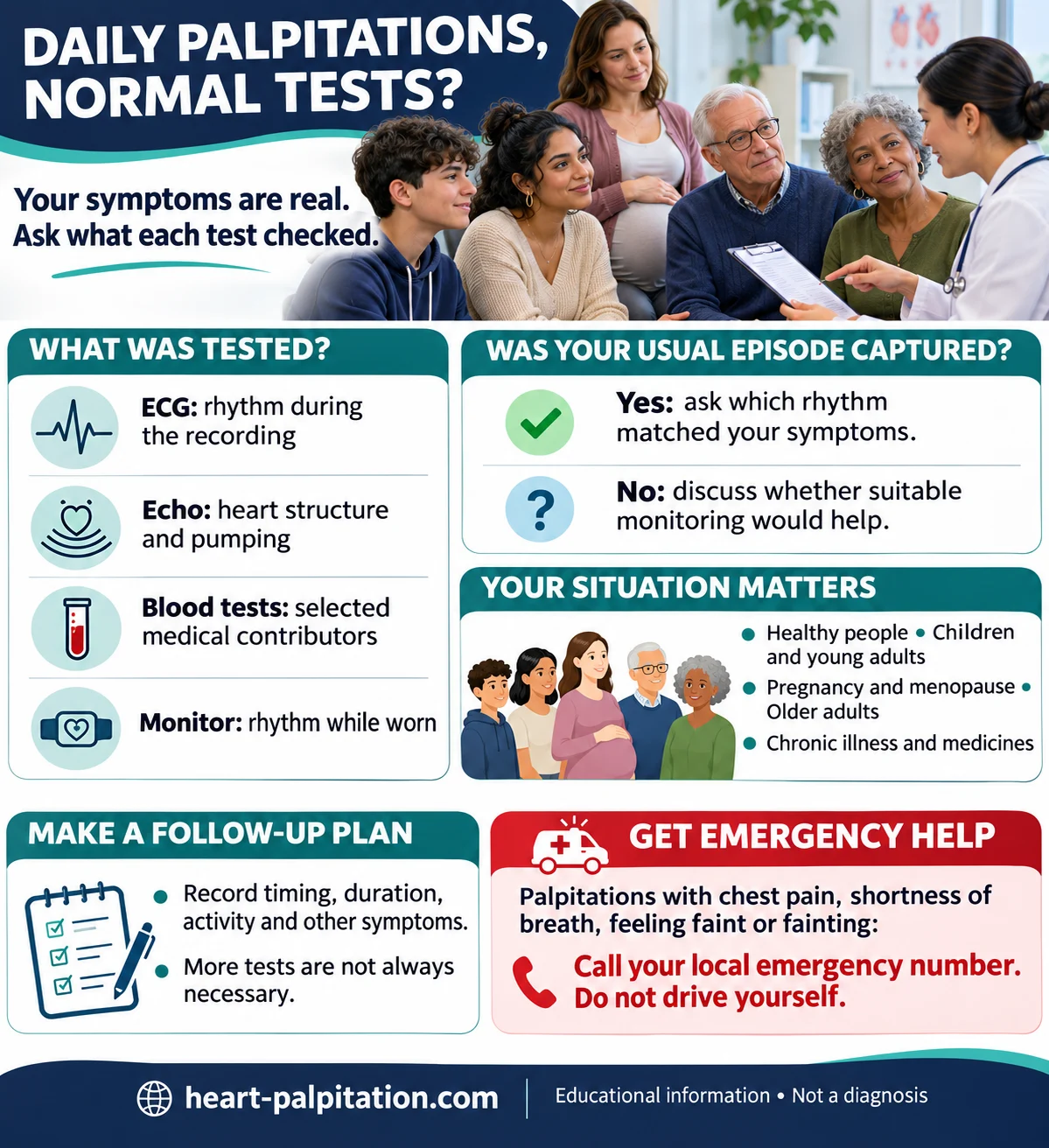
Different scenarios by age, sex, life stage and chronic illness
These examples explain why daily palpitations do not lead to the same next step for everyone. They illustrate possibilities rather than diagnose your symptoms. Start with what was recorded, then consider the history, examination and what remains unexplained.
Otherwise healthy men and women with repeated thumps
For example, a healthy adult may notice daily isolated thumps at rest, and a monitor records only occasional extra beats during those exact sensations. With a reassuring examination and no concerning history, the clinician may explain the result and focus on symptom management rather than ordering another scan.
The same approach can apply to males and females. What matters is the symptom–rhythm match and overall risk, not how alarming a thump feels. If the pattern changes to prolonged racing, exertional symptoms or faintness, return for assessment.
Children and teenagers
A child or teenager may have a normal ECG after an episode has ended. If sudden racing keeps recurring, a pediatric clinician can decide whether a monitor and other assessment are needed. Age-appropriate heart-rate interpretation is essential; adult thresholds and smartwatch algorithms should not be used to dismiss or diagnose a child’s symptoms.
Discuss fever, dehydration, energy drinks, nicotine or vaping, and asthma or stimulant medicines calmly. Fainting during exercise, palpitations before fainting or a family history of sudden unexplained death requires particular attention despite normal initial tests. Do not stop essential treatment or ask a child to provoke symptoms to obtain a recording.
Young adults, students and athletes
A young man or woman may have daily pounding during poor sleep, exam stress or stimulant use, with sinus rhythm recorded during symptoms. That finding helps direct care toward the circumstances and any relevant medical contributors. It does not make the symptoms imaginary or automatically establish an anxiety disorder.
A different scenario is abrupt racing during sport or an episode accompanied by near-fainting. Youth and fitness do not exclude an electrical heart condition. Stop activity if it causes concerning symptoms and obtain medical advice before returning to strenuous exercise; avoid testing your limits while waiting for assessment.
Menstrual bleeding, iron deficiency and female patients
A woman with heavy periods, fatigue and daily pounding may have a normal echo yet need a blood count and iron assessment. Normal heart structure does not exclude anemia, and a normal hemoglobin does not always exclude low iron stores. The clinician should investigate the reason for any deficiency.
Track a suspected cycle-related pattern if it helps the history, but do not assume hormones explain every episode. Men and women without periods can also develop anemia or thyroid disease. Recurrent unexplained symptoms need an individual assessment, not a conclusion based on sex alone.
Pregnancy and after childbirth
During pregnancy, a faster or more noticeable heartbeat can occur, and typical symptoms recorded with sinus rhythm may be reassuring. Persistent symptoms may still warrant review for anemia, thyroid disease, infection or other causes. Coordinate the assessment with your maternity team rather than independently changing medicines.
After a recent birth, do not assume daily palpitations are simply tiredness or hormones. New fast or pounding heartbeat warrants prompt advice, while chest pain, breathlessness or faintness needs emergency assessment. A previous normal ECG or echo does not exclude a new pregnancy-related cardiac or circulatory problem.
Perimenopause and menopause
Daily palpitations may accompany hot flushes, night sweats and disturbed sleep. If a typical episode is captured with reassuring rhythm, that can help explain what happened. Discuss the impact of menopausal symptoms and what treatment options fit your overall health.
Thyroid problems, anemia and arrhythmias may coexist with menopause, so an assumed hormonal explanation should not end the assessment. A new irregular or sustained racing pattern deserves review. Menopause treatment should be chosen individually rather than used as a substitute for evaluating concerning symptoms.
Middle-aged and older adults
For an older man or woman, normal blood tests and an ECG between episodes may still leave an intermittent irregular rhythm unexplained. Age, hypertension, heart disease and other history influence whether monitoring is appropriate. New exercise intolerance, falls or unexplained fainting should be mentioned.
If a monitor has captured the usual daily symptoms with a reassuring rhythm, further tests may not be needed. Review medicines and arrange follow-up instead of assuming either that age makes every palpitation dangerous or that symptoms are inevitable with aging. New chest symptoms or breathlessness require their own assessment.
Diabetes and glucose-lowering treatment
A person using insulin or a sulfonylurea may feel racing, sweating and shaking during low glucose, even with sinus rhythm. A normal ECG or HbA1c does not rule out an individual low. Check glucose when possible and follow your established hypo treatment plan.
Do not attribute every episode to glucose. Diabetes can coexist with kidney disease, autonomic problems and heart disease, so discuss recurrent symptoms and medication timing with your team. Emergency cardiac warning signs still require help, even if glucose readings or previous tests appear reassuring.
Thyroid disease, anemia and chronic inflammatory illness
A fast sinus heartbeat may accompany overactive thyroid function, excessive thyroid replacement or anemia. A monitor may show the rhythm without establishing its medical cause. Existing results, new symptoms and treatment changes help determine whether targeted blood testing is useful.
Chronic inflammation can complicate interpretation of iron measurements, so treatment should follow a clinical review rather than self-prescribed supplements. Do not alter thyroid medicine or start iron solely because palpitations persist. An irregular or abruptly racing episode may need rhythm assessment as well as treatment of an underlying illness.
Kidney disease, heart failure or known structural heart disease
A previously normal test does not remove the significance of chronic heart or kidney disease. Electrolytes, fluid balance, medicines and changes from your baseline can be relevant. Your usual care team should help interpret persistent symptoms and decide whether blood tests, rhythm monitoring or another assessment would change treatment.
Do not increase fluids or salt or take potassium or magnesium without advice. New swelling, worsening breathlessness or needing more pillows warrants prompt review; sudden or severe breathlessness, chest pain or faintness needs emergency help. Do not change diuretics, anticoagulants or other heart medicines yourself.
Asthma, COPD, sleep apnea and postural symptoms
Palpitations after a reliever inhaler may call for a medication and breathing review rather than repeated cardiac scans. Snoring and gasping may suggest a sleep assessment, while racing with standing may lead to posture-related pulse and blood-pressure checks. A normal ECG does not diagnose or exclude these other problems.
Keep using essential prescribed medicines unless a clinician advises otherwise and explain any increased reliever use or changed symptoms. These conditions can occur alongside arrhythmias. New breathlessness or faintness should not be dismissed as “the usual condition” because an earlier test was normal.
What to do next if every test is normal
- Describe the feeling precisely. Is it a single thump, a steady racing pulse, a flutter or irregular beats? How long does it last?
- Keep a short symptom diary. Record time, activity, duration, any measured pulse and symptoms such as dizziness or breathlessness.
- Ask whether your typical symptoms were captured. A monitor that records normal rhythm during the symptom may spare unnecessary repeat testing.
- Review medications and triggers. Include over-the-counter stimulants and any recent dose changes.
- Discuss targeted next steps. A clinician may choose no further investigation, longer monitoring, an echocardiogram, directed blood tests or exercise evaluation, depending on the findings.
- Address the impact on daily life. If investigations are reassuring, coping strategies, sleep, graded activity where medically appropriate and treatment of anxiety or heightened heartbeat awareness may help.
For practical measures that may reduce triggers, see How to Stop Heart Palpitations Safely. Avoid taking supplements or extra heart medicines to treat an undiagnosed rhythm.
Agree on a follow-up plan: what to try, when to review the symptoms and what change needs earlier attention. Make manageable changes one at a time rather than removing whole food groups, avoiding all activity or checking your pulse throughout the day. Activity advice should be individualized if you have exercise symptoms or chronic illness.
You do not need to prove that the symptoms are severe before explaining their impact on sleep, work, school or confidence. When findings are reassuring, care can still focus on reducing distress and improving daily life. If a new episode feels different or brings warning signs, seek reassessment rather than applying old reassurance to it.
When normal tests are not enough
Call your local emergency number for current palpitations with chest pain or pressure, shortness of breath, feeling faint, fainting or collapse. Do not drive yourself. A previous normal test or smartwatch reading must not delay care. If these warning symptoms have stopped, arrange an urgent medical assessment.
Arrange timely medical review for new or worsening daily palpitations, exertional episodes, a personal history of heart disease, or a family history of sudden cardiac death. Previous normal results do not replace evaluation of a new concerning symptom.
Most Asked Questions
Are daily heart palpitations normal if my ECG is normal?
They can occur in otherwise healthy people, but a normal resting ECG does not evaluate every moment of the day. Your symptoms and risk factors determine whether additional monitoring is appropriate.
If your usual symptoms have been captured with a reassuring rhythm and there are no new risk features, your clinician may focus on triggers and symptom relief. If the episodes were not captured, suitable monitoring may be more useful than repeating the same brief ECG.
Why do I still have palpitations after normal blood tests?
Blood tests assess selected causes such as anemia or thyroid problems. They do not directly capture an intermittent arrhythmia or determine whether you are feeling premature beats.
Ask which tests were done and what they made less likely. New symptoms, medicine changes or chronic illness may justify targeted review, but a bigger blood panel does not replace recording the rhythm.
What if I feel palpitations during a normal Holter recording?
That correlation may be reassuring if the tracing shows sinus rhythm or only low-risk beats during the typical symptom. Your clinician should interpret the complete recording and your history.
Ask whether that was genuinely your usual episode and whether the relevant tracing was readable. A reassuring match can reduce uncertainty about those symptoms without guaranteeing that every future episode will be identical.
Should I repeat all my cardiac tests?
Not automatically. When initial results are reassuring, reviewing the symptom pattern, timing and whether episodes were recorded often provides more value than repeating tests without a clear reason.
Agree what question any proposed repeat test would answer and what would change management. A planned review is usually more useful than repeating investigations solely for short-lived reassurance.
Can anxiety cause palpitations every day?
Yes, stress and heightened heartbeat awareness can contribute, but anxiety should not be assumed to be the cause without appropriate assessment.
Support for anxiety can be offered alongside medical care, particularly when typical symptoms have been recorded with reassuring rhythm. New faintness, exertional symptoms or a changed racing pattern should still be assessed.
Related Guides
Medical References
- Gauer RL, Thomas MF, McNutt RM. Palpitations: Evaluation, Management, and Wearable Smart Devices. American Family Physician. 2024. Read review.
- NICE. Atrial fibrillation: diagnosis and management (NG196), recommendations on ambulatory monitoring. Read guidance.
- Merck Manual Professional. Palpitations, testing and ambulatory ECG monitoring. Read medical reference.
- NHLBI: Arrhythmias—Diagnosis.
- NHS: Heart palpitations.
- American Academy of Pediatrics: Dizziness and Fainting in Children and Teens.
- CDC: Urgent Maternal Warning Signs.
- NHS: Menopause and perimenopause symptoms.
- NIDDK: Low Blood Glucose.
- NHS: Postural tachycardia syndrome.
Medical disclaimer: This article is educational and does not replace diagnosis or treatment by a clinician. New severe symptoms or palpitations with fainting, chest pain or severe breathlessness require emergency care.
Explore this topic: Heart Palpitation Tests & Normal Results — complete diagnostic guide.