
Nighttime, Sleep & Position
Heart Palpitations When Lying on the Left Side: Why?
Feeling a stronger heartbeat on your left side is often related to position and increased awareness, but persistent or concerning symptoms still deserve assessment.
Written by: Dr. Albana Greca, MD, MMedSc, IDF Fellow, Family Physician
Medically reviewed by: Dr. Benard Shehu, Cardiologist
Quick Answer
Feeling a stronger heartbeat on your left side is often related to position and increased awareness, but persistent or concerning symptoms still deserve assessment. If symptoms are new, frequent or accompanied by warning signs, discuss them with a clinician rather than assuming they are harmless.
Key Medical Takeaways
- The sensation of palpitations does not establish an arrhythmia.
- Timing, duration, other symptoms and the recorded rhythm guide next steps.
- Recurrent symptoms may require ambulatory ECG monitoring even if a resting ECG is normal.
- Chest pain, fainting or severe breathlessness require emergency care.
Why can your heartbeat feel stronger on the left side?
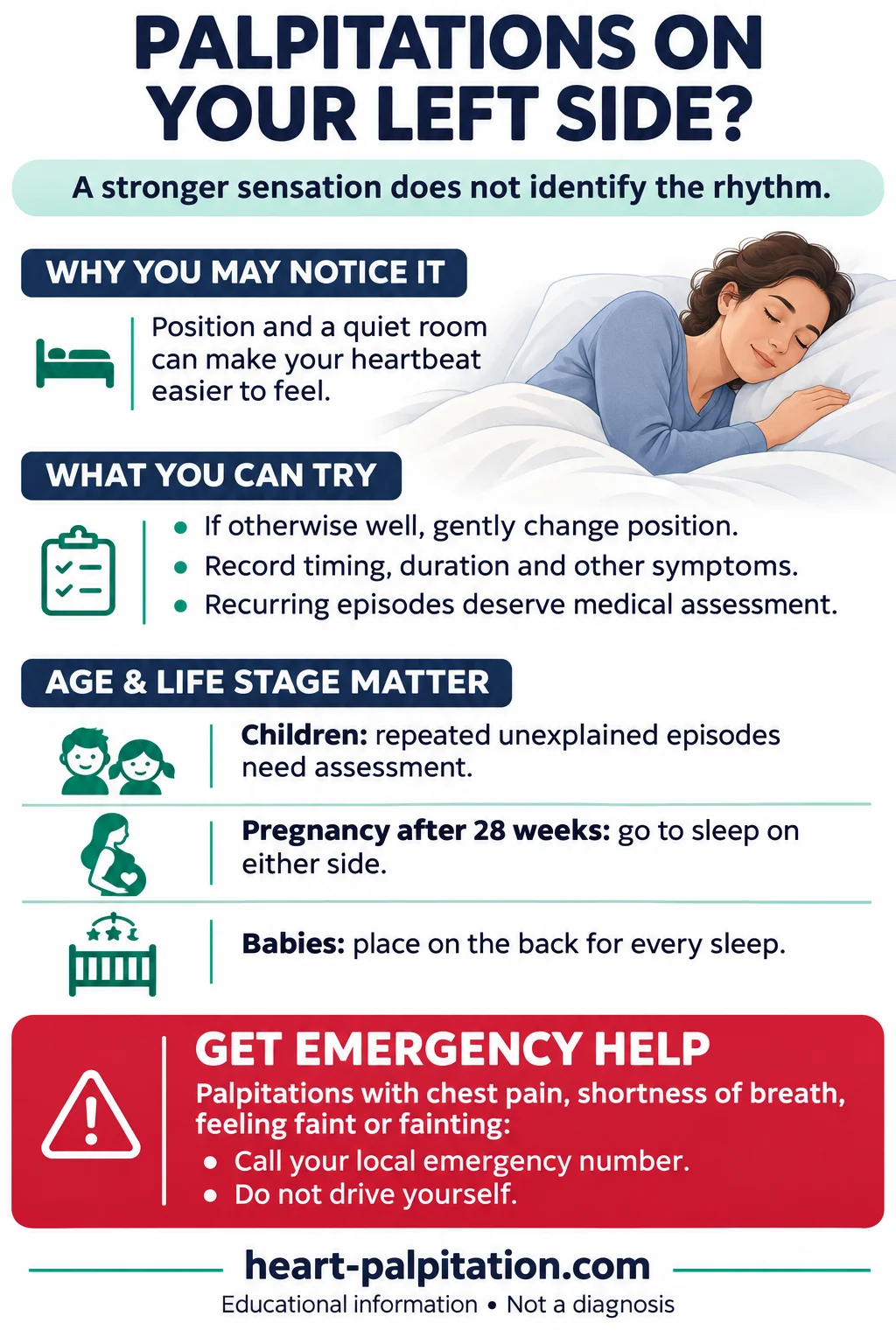
When you roll onto your left side, you may suddenly become aware of a thump or pounding sensation that you barely noticed before. One possible explanation is that this position makes the heart’s movement easier to feel against the chest wall. A quiet room and fewer distractions can make the sensation more noticeable too.
A heartbeat that feels stronger has not necessarily become faster or abnormal. The important questions are whether it feels regular, whether the change begins abruptly, how long it lasts and whether you feel unwell. The position is a useful clue, but it cannot diagnose the rhythm.
I understand that feeling your heart against the mattress can make you worry that the position is harming it. For most people, simply noticing the heartbeat does not mean that left-side sleeping is dangerous. However, new, persistent or recurrent symptoms deserve assessment rather than reassurance based on position alone.
Is it an arrhythmia or normal heartbeat awareness?
A strong, evenly timed heartbeat may be normal sinus rhythm. An extra beat followed by a pause can feel like a skipped beat or sudden thump; premature atrial contractions and premature ventricular contractions are possible explanations. These descriptions help a clinician, but they do not establish a diagnosis.
An abruptly racing, sustained or irregular heartbeat may need ECG recording. Some people with an existing arrhythmia notice a positional pattern, so it would be too simple to say that left-side symptoms are always increased awareness. A small questionnaire study in selected patients with known paroxysmal AF found self-reported positional triggers; it did not show that left-side sleeping causes AF in the general population.
If changing position makes the sensation fade, record that detail without treating it as proof that the rhythm was harmless. A resting ECG or longer monitor can help when episodes keep returning. Your symptoms, examination and health history determine which investigations are appropriate.
Why do palpitations feel worse at bedtime?
At bedtime there is less background noise and activity competing for your attention. You may notice ordinary heart movement or isolated extra beats more clearly than during a busy day. Once the sensation worries you, repeated pulse checking can keep your attention focused on it and make settling to sleep harder.
Evening caffeine, energy drinks, nicotine, alcohol, poor sleep and certain medicines may contribute in males and females. Large late meals or reflux may add chest discomfort, but digestive symptoms should not automatically be used to explain a racing or irregular heartbeat.
Tell your doctor if bedtime symptoms also involve gasping, snoring, witnessed breathing pauses or daytime fatigue. Sleep apnea can affect younger and older people and both sexes. Being comfortable on a different side does not exclude a sleep-related breathing problem.
What can you try safely?
If you are otherwise well, gently roll to a more comfortable position or sit up slowly and see whether the sensation changes. Breathe normally and avoid repeatedly checking your pulse. A comfortable position may help you settle, but it is not a treatment for an arrhythmia.
Look for manageable patterns rather than eliminating everything at once. Consider reducing late caffeine or alcohol, allowing time for sleep and keeping a short symptom diary. If reflux is a problem, avoid lying down for about three hours after meals. Do not take extra heart medication, sedatives, potassium or magnesium supplements to suppress symptoms without advice.
If you feel faint, sit or lie down safely and get help rather than walking around to test the symptoms. Palpitations with chest pain, shortness of breath or current faintness need emergency assessment. Follow any condition-specific sleep advice from your clinician; pregnancy and infant sleep have separate recommendations, explained below.
Advice for different ages and life stages
Children, teenagers and younger adults
Children and teenagers can notice heartbeats while resting, and heart rate must be interpreted for their age. Fever, dehydration, asthma or stimulant medicines, caffeine and energy drinks may contribute, while an arrhythmia is also possible. Ask a young person to describe the sensation calmly rather than assuming it is anxiety.
Repeated unexplained episodes need assessment, particularly with exercise symptoms, fainting or an important family history. Adult position advice does not apply to infant safe sleep: babies should be placed on their backs for every sleep on a firm, flat sleep surface. Do not place a baby on the side or use sleep positioners to manage a perceived heartbeat problem.
Males and females in adulthood
The same principles apply to men and women: the sleep position alone does not tell us the cause. Review symptoms, medicines, stimulants, sleep and relevant medical conditions. In someone with heavy periods, fatigue or breathlessness, assessment for iron-deficiency anemia may be appropriate; thyroid disease and other causes can affect either sex.
Perimenopause and menopause can bring palpitations and sleep disruption, but new or persistent symptoms should still be assessed. Likewise, symptoms in a man should not automatically be labelled heart disease without investigation. The goal is an individual assessment rather than assumptions based on sex.
Pregnancy and after childbirth
During pregnancy, palpitations may become more noticeable, but new or persistent episodes should be discussed with your maternity team. After 28 weeks, go to sleep on your side: either the left or right side is acceptable. If the left side makes your heartbeat uncomfortable, you do not have to force yourself to stay on it; supportive pillows may help.
If you wake on your back, simply turn onto your side before returning to sleep. During pregnancy or after a recent birth, seek prompt advice for a new fast or pounding heartbeat and emergency help if it comes with chest pain, breathlessness or faintness. Do not assume that these symptoms are only hormones, tiredness or sleep position.
Older adults and people with known heart disease
For older men and women, a new pattern of irregular or sustained racing deserves attention, especially with known AF, valve disease or heart failure. Bring a medication list and describe whether symptoms occur only on one side, in any lying position or during the day as well.
New breathlessness when lying flat, waking gasping or needing more pillows should be reported promptly. Sudden or severe breathlessness, chest pain or faintness needs emergency assessment. Changing position for comfort should not replace evaluation or changes to treatment agreed with your clinician.
When might testing help?
Arrange assessment if episodes are new, worsening, frequent, prolonged or troubling enough to disturb your sleep. Mention known heart disease, symptoms with exercise or a family history of sudden unexplained death. Being young, female, male or physically fit does not by itself rule out a rhythm disorder.
Your clinician may examine you and arrange a 12-lead ECG. If symptoms come and go, a Holter, patch or event monitor can help connect the sensations with your actual rhythm. Blood tests for anemia, thyroid problems or electrolyte disturbances are selected according to your history; an echocardiogram is used when structural heart disease is suspected.
Bring the timing, duration, body position and associated symptoms, plus any existing smartwatch ECG. Do not deliberately provoke distressing episodes or delay care to get a recording. I want us to find an explanation and a practical plan so that you can feel more confident about going to bed.
Emergency Warning Signs
Call your local emergency number for palpitations with current chest pain, shortness of breath, feeling faint, fainting or collapse. Do not drive yourself. Do not delay help to see whether rolling over makes the symptoms disappear.
If those warning symptoms have stopped, arrange an urgent medical assessment. A previous normal ECG does not rule out a new emergency. For a baby or child, serious breathing difficulty, blue or gray lips, collapse or abnormal unresponsiveness also requires emergency help.
Most Asked Questions
Is it dangerous to sleep on the left side?
Simply noticing your heartbeat on the left side does not mean that the position is dangerous. Many people become more aware of normal heart movement or extra beats when lying quietly.
What matters is the full picture: a new irregular or sustained racing heartbeat, faintness, chest pain or breathing difficulty should not be dismissed because it happens in bed. Follow any individual advice given for pregnancy, known heart disease or another medical condition.
Should I avoid sleeping on my left side?
If you are otherwise well, you can choose a comfortable position. Rolling to the right may reduce the sensation, but there is no universal sleep position that prevents or treats every arrhythmia.
During pregnancy after 28 weeks, either side is acceptable when going to sleep. For babies, use back sleeping rather than applying adult side-sleeping advice. If discomfort continues to prevent sleep, discuss it with a clinician instead of repeatedly testing positions all night.
Can PVCs feel stronger when lying down?
Some people feel isolated premature beats more strongly when resting quietly or lying in a particular position. A PVC may be perceived as a pause followed by a stronger thump, but symptoms alone cannot confirm that it is a PVC.
If extra beats are new, frequent or associated with other symptoms, seek assessment. Your clinician may use a rhythm recording and, when indicated, other tests to interpret them in the context of your heart health. Do not assume every thump requires treatment or that every positional thump is harmless.
Related Articles
Medical References
- Gauer RL, Thomas MF, McNutt RM. Palpitations: Evaluation, Management, and Wearable Smart Devices. American Family Physician, 2024. Source.
- National Institute for Health and Care Excellence. Atrial fibrillation: diagnosis and management (NG196). Guideline.
- American Heart Association. Sleep apnea and cardiovascular disease. Further information.
- BHF: Heart palpitations at night.
- NHS: Heart palpitations.
- Gottlieb et al. (2021): Self-reported onset of paroxysmal AF and sleeping position.
- NHS: Tiredness and sleep problems in pregnancy.
- American Academy of Pediatrics: Back to Sleep.
- CDC: Urgent Maternal Warning Signs.
- NHLBI: Arrhythmias—Diagnosis.
Explore more: Nighttime, Sleep & Position — Heart Palpitations Guide